Yesterday I was at Golden Jubilee Hospital in Clydebank for another MRI scan – over the last few years I’ve had quite of few of these so knew what to expect.

No matter how many MRI scans I have or how frequently I have them, I’m still surprised by just how loud they are. I hadn’t been feeling that well before I went in for my scan, but by the time my scan was finished my head was absolutely thumping.
For those of you who have never had an MRI scan before, let me just explain to you a little bit about MRI scans…
Magnetic resonance imaging (MRI) is a type of scan that is often used to diagnose health conditions that affect organs, tissue and bone.
MRI scans use strong magnetic fields and radio waves to produce a detailed image of the inside of the body. The device that carries out MRI scans is known as an MRI scanner. The scanner consists of a large tube that contains a series of powerful magnets. The patient lies inside the tube during the scan.
Magnetic resonance imaging (MRI) can be used to look at almost any part of the body. It is most often used to study:
- the brain and spinal cord,
- the heart and blood vessels,
- other internal organs, such as the lungs or liver,
- bones and joints, and
- breasts.
For some MRI scans, you will be given an injection of a special dye, known as a contrast agent. This makes certain tissues and blood vessels show up more clearly and with greater detail on the scan.
As MRI scans are painless, anaesthetic is not usually required.
An MRI scanner is a short tunnel which is open at both ends. During the procedure, you lie on a motorised bed, which is moved inside the scanner.
A small receiving device is placed behind or around the part of your body being scanned. You are moved into the scanning tube, either head or feet-first, depending on which part of your body is being scanned.
A computer is used to operate the MRI scanner. The computer is located in a different room to the scanner to keep it away from the magnetic field generated by the scanner.
As the radiographer operates the computer, they will also be in a separate room to you. However, you will be able to talk to them, usually through an intercom, and they will be able to see you at all times on a television monitor.
During your scan, a friend or family member may be allowed to stay in the room with you. Children can usually have a parent with them. Anyone who stays in the scanner room with you will be asked the same questions as you about pacemakers and metal objects in their body, and will have to follow the same guidelines about clothing and removing metallic objects.
To avoid the images being blurred, it is very important that you keep the part of your body being scanned still throughout the procedure. Depending on the size of the area being scanned and how many pictures are taken, a typical scan lasts between 15 and 90 minutes.
At certain times during the procedure, the MRI scanner will make a loud knocking noise. You may be given earplugs or headphones to wear. The noise is caused by the magnets in the machine being turned on and off.
After your scan has been completed, you will be moved back out of the scanner.
MRI scans are usually performed as an outpatient procedure, so there is no need for an overnight stay in hospital. Once the scan is over, most people can resume their normal activities immediately.
(The above is an extract from the NHS information pages on MRI scans – so please refer there for further information)
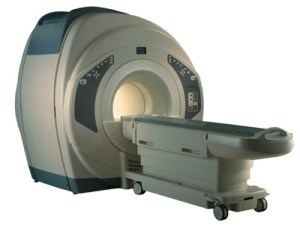
I know the above just talks about a “loud knocking noise”, but that’s a little bit of an understatement as it makes more than just some loud knocking noises!
So why am I writing this? Well, here’s my plea to all you scientists out there, please, please, please can someone develop a silent MRI scanner soon! I’m sure I can’t be the only person who’s ended up with a thumping headache after an MRI scan, so please, for anyone who has ever had (or will have in the future) an MRI scan, we’d appreciate it if a quieter one could be developed.
Thank you.
 The Distinct Dot
I never knew they were noisy! You learn something new everyday! 🙂
LikeLike
Glad I was able to educate you today 🙂
LikeLike